
DeKalb Projected Versus Actual Release
IDOC’s public record uses Projected Parole Date for the estimated prison-exit date of a person still in state custody. It may also show Projected Discharge Date, the expected end of the full IDOC sentence and supervision relationship. Those fields answer different questions. A later profile with status PAROLE and an actual Parole Date indicates that physical prison release occurred and state supervision began.
A DeKalb County Jail detainee follows another route. A pretrial case turns on the judge’s detention or release order, processing, and any other warrant or hold. A short county sentence is calculated from the sentencing order, time already spent in custody, and any lawful credit applied by the Sheriff or court. The public IDOC projection does not apply unless the person was committed to state prison.
Find a DeKalb Release Date
First identify whether the person is in county jail, IDOC, federal custody, or another system. A name missing from the DeKalb jail source may reflect release or transfer. The Circuit Clerk case search can show the order, sentence, and custody credit, while the Sheriff keeps the physical movement record.
- Confirm the current custodian and match the person by reliable identifiers.
- For IDOC, open the Individual in Custody Search and search by last name, IDOC number, or birth date.
- Read the overall status before the dates. IN CUSTODY differs from PAROLE.
- Compare Projected Parole Date, Parole Date, and Projected Discharge Date without treating them as synonyms.
- Inspect each sentence count and its discharged flag because one finished count can coexist with another active count.
- For DeKalb County Jail, obtain the court order and ask the Sheriff for the sentence calculation or exact discharge or transfer time.
If the live IDOC search has no result, retry exact identifiers. IDOC says its live profiles focus on people incarcerated or still on parole or MSR. A fully discharged former prisoner may no longer appear. Use IDOC FOIA or the public information-release route for archived fields.
Read DeKalb IDOC Date Labels
The overall record should guide the interpretation. Sentence rows add detail but cannot override an active status elsewhere in the profile. These combinations prevent the most common errors.
| Displayed combination | Meaning |
|---|---|
| IN CUSTODY and future Projected Parole Date | The person remains in IDOC; the date is an estimate of prison exit. |
| PAROLE and Parole Date | The profile reports physical release from prison to parole or MSR on that date. |
| Projected Discharge Date | The expected end of IDOC supervision and sentence control, not the gate date. |
| Sentence Discharged: YES | That count ended; other counts or the overall sentence can remain active. |
| No public result | Possible full discharge, mismatch, no IDOC history, or a system issue; it is not proof of release. |
IDOC’s public label PAROLE can include modern mandatory supervised release. Classic discretionary parole is generally tied to old indeterminate sentences and narrow statutory categories. The label must be read with the sentence and PRB context rather than used as a broad claim that a board granted release.
DeKalb IDOC Release Search
The official IDOC offender search shows the fields used to distinguish custody, prison release, and projected discharge.
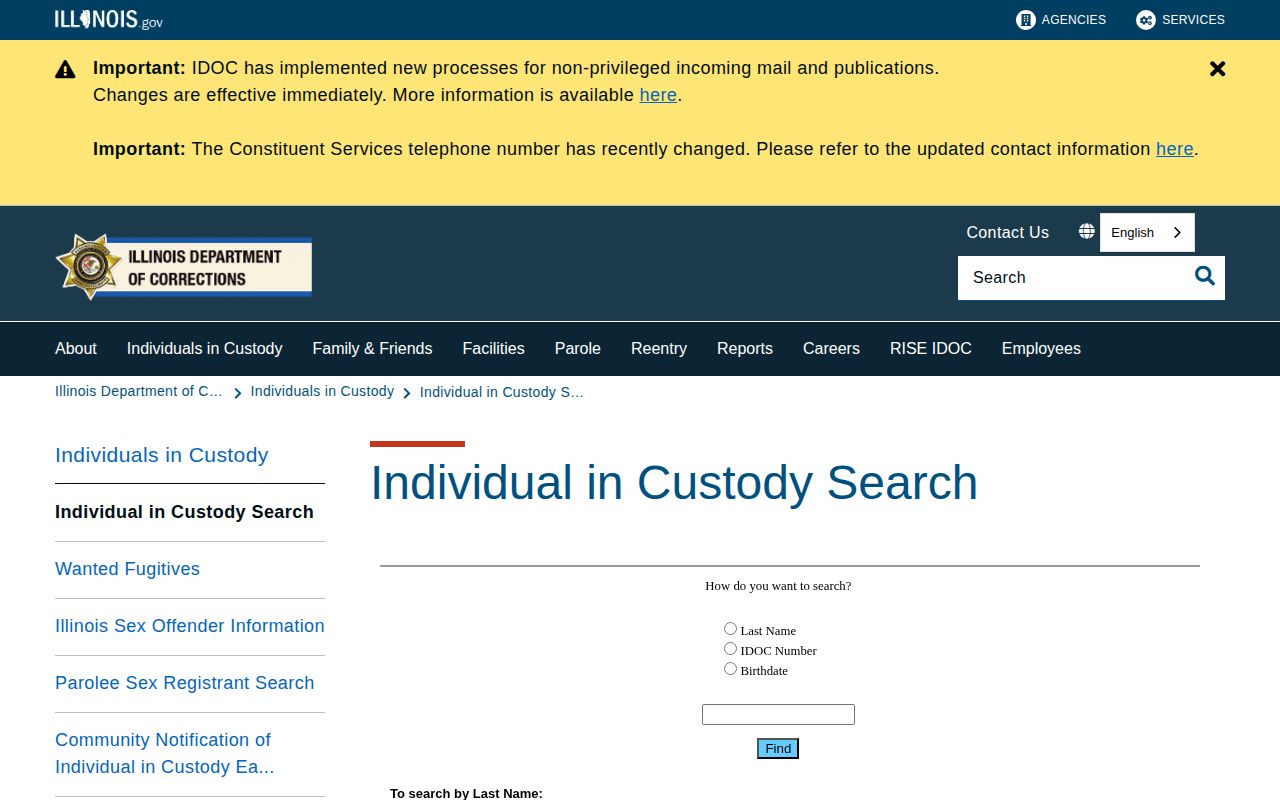
The search form accepts state identifiers and name details, but a matching profile still must be checked against all status and sentence rows.
Illinois Credit Shapes Release Dates
730 ILCS 5/3-6-3 is Illinois’s core sentence-credit law. It does not create one universal 85 percent rule. The conviction, offense date, amendments, sentencing findings, and statutory eligibility determine the calculation. IDOC summarizes common service categories as 50, 75, 85, or 100 percent, but those figures are categories rather than a calculator for an individual case.
Some first-degree murder categories require full service. Certain listed violent offenses allow no more than 4.5 days of credit per month, often described as about 85 percent service. Some listed drug sentences can be limited to 7.5 days per month, often described as about 75 percent. Eligible nonlisted determinate sentences may receive one day of credit for each day served, commonly called 50 percent. The exact subsection and conviction date control.
IDOC also describes Program Sentence Credit and Earned Sentence Credit. Eligible programming can yield one-half day for a successful program day, though people in 85 and 100 percent categories are not eligible for that program credit. Earned Sentence Credit can be up to 180 days in an individualized, discretionary review. Eligibility is not an award, so it should not be subtracted from a date in advance.
Note: Sentence-credit law supplies inputs to IDOC’s calculation; only the current official record can show the date produced for a specific sentence.
Why DeKalb Release Dates Move
IDOC Directive 01.07.400 explains projected and mandatory date calculations for determinate sentences. The display can change when a lawful input changes. A move does not by itself show an error.
| Factor | Possible effect |
|---|---|
| Custody or jail credit | A corrected amount of qualifying pre-sentence time changes the calculation. |
| Credit award, loss, or restoration | Program, earned, statutory, or disciplinary credit can move the projected date. |
| Amended court information | A corrected sentence or later order changes the legal terms sent to the custodian. |
| Consecutive sentences | Terms may be aggregated, moving the controlling date beyond one count’s date. |
| Detainer or warrant | Another agency may take custody even when the current custodian releases the person. |
| Absence from supervision | Lost time can affect the mandatory date under the governing rules. |
| PRB violation decision | Revocation can return a supervised person to custody and require recalculation. |
The IDOC sentence-calculation directive is the best technical source for state calculations. It still cannot predict a court change or another agency’s hold.
DeKalb County Jail Date Rules
A county jail sentence is not calculated by copying state-prison percentages. 730 ILCS 5/5-4.5-100 governs credit for time in custody, while the sentencing order and applicable law supply the local term. No verified DeKalb-specific public good-time formula or weekend-advance policy was found. Ask the Jail and court for the actual calculation instead of assuming a common jail practice.
Pretrial detention has even less certainty. A hearing can lead to release conditions, continued detention, or a later change. Processing may also be affected by a separate warrant, IDOC commitment, or federal or immigration hold. The docket can explain legal authority, but the Sheriff’s record supplies the completed physical departure time.
- Projected parole date
- IDOC’s estimate of prison exit for a person still in custody.
- Parole date
- The recorded date of physical prison release to supervision.
- Projected discharge date
- The expected end of IDOC’s full sentence and supervision relationship.
- Detainer
- A request or legal basis for another agency to assume or maintain custody.
Confirm DeKalb Actual Release
Use a timeline rather than one generic date. For county custody, pair the signed order with the Sheriff’s received, discharged, or transferred timestamp. For state custody, pair overall IDOC status with the actual Parole Date and the projected end of supervision. A transfer to IDOC proves departure from DeKalb County Jail, but it does not show community release.
Illinois VINE can send a pending custody-change alert. Registration and PIN details are covered in the DeKalb County VINE inmate check. After an alert, verify the event with the agency that supplied it. For a projected state date, recheck the live profile because sentence-credit and legal inputs can change.
A fully discharged IDOC profile can disappear from the live lookup. Archived IDOC public information and the sentencing court then become important. Keep each milestone distinct: booking, court release order, jail discharge, prison admission, prison release, supervision, and final discharge. Note: A future date supports planning, but only the custodian’s completed-event record confirms that release occurred.
DeKalb Sentence Records and Dates
An IDOC profile can show more than one sentence count. Each row may list a mittimus or case number, offense, class, custody date, sentence length, county, and whether that count is discharged. A person can have one row marked YES while another remains active. Always compare every row with the overall status at the top of the profile. The overall custody state and controlling active terms decide whether prison release has occurred.
The sentencing court remains important because IDOC calculates from the legal information it receives. An amended order, corrected custody credit, or consecutive-term ruling can change an earlier projection. For a DeKalb conviction, use the Circuit Clerk docket to locate the case and request the signed order when exact language matters. The docket describes judicial events, while IDOC’s current profile shows how state custody and release fields are displayed.
IDOC publicly identifies admission and release dates, status or location, vital information, and sentencing information for qualifying current or former records. Other master-record material can remain confidential. After full sentence completion, the live result may disappear under IDOC’s stated display practice. A narrow archived request that supplies the IDOC number, name, and case can seek the allowable former-record fields without assuming website absence proves release.
DeKalb Parole Date Context
Illinois uses the word parole in two related but different ways. Classic discretionary parole generally concerns indeterminate sentences from the pre-1978 system. Modern determinate sentences usually lead to mandatory supervised release after the calculated prison term. IDOC may still label the public status PAROLE and the prison-exit field Parole Date. Report that public label as shown while explaining the legal form.
730 ILCS 5/3-3-3 governs old-law eligibility and excludes ordinary determinate terms from that classic structure. Youthful-parole and medical-release laws create specific exceptions. A future Projected Parole Date on a modern IDOC profile normally reflects sentence calculation, not a promise that PRB will vote to grant release on that day.
The supervision term also varies by offense, date, class, and statutory exception. Do not attach a generic term to a named person. Read the profile’s Projected Discharge Date, then confirm the controlling agency record. Prison release and final state discharge remain separate milestones.
Build a DeKalb Release Timeline
Dates from different custodians can all be accurate because they describe separate events. The arrest and jail receipt start the local custody record. A judge may later sign a release order. The jail then completes physical discharge or transfer. If the destination is IDOC, the state admission begins a new custody segment. Prison release to MSR comes later, and final discharge may occur after a period of community supervision.
| Milestone | Responsible source |
|---|---|
| Jail receipt and physical departure | DeKalb County Sheriff booking and movement record. |
| Release authority or sentence | Twenty-Third Judicial Circuit order and docket. |
| IDOC admission and projection | IDOC profile and sentence calculation. |
| Prison release | IDOC actual Parole Date and overall status. |
| Supervision end | IDOC or PRB final discharge record. |
A single field should never be stretched across the whole timeline. The Sheriff’s transfer date can precede IDOC admission, and the projected discharge can be years after the prison exit. Label each date with its event and custodian.
Public Record Search
Sponsored Results