
Understanding DeKalb County Releases
“Released” means that one agency's physical custody ended. It does not always mean the person walked out with no conditions. A judge may order pretrial release, a short county sentence may end through time served and credit, or charges may be dismissed. The jail may instead transfer someone to the Illinois Department of Corrections, another county, a hospital, federal authorities, or immigration authorities. Each event removes the person from DeKalb County Jail custody, but only some are community releases.
The record trail depends on the event. The Sheriff records the physical receipt, movement, discharge, or transfer. The Twenty-Third Judicial Circuit docket supplies the court order, case outcome, sentence, and conditions. IDOC records a state commitment and later prison release. Illinois VINE can report a custody change, but its alert may not explain the legal cause. A name missing from a current-custody view is therefore a clue, not proof.
- Discharge
- Custody or supervision ends under the controlling sentence or order.
- Time served
- The imposed jail term is satisfied by days already held and lawful credit.
- Parole or MSR
- Prison custody ends, while IDOC community supervision continues.
- Transfer
- One custodian hands the person to another agency or facility.
DeKalb County Release Types
The release code matters as much as the time stamp. Illinois now uses court-ordered pretrial release rather than money bail as the general rule. Older county material may still use bond language, so the current docket should control. Electronic Home Monitoring is also not a full discharge. It is a local custody alternative with GPS limits and program rules.
| Event | What it means | Next record |
|---|---|---|
| Pretrial release | The case continues outside jail under a court order. | Circuit Clerk docket and Pretrial Services |
| Time served | The local jail term and credit have been satisfied. | Sheriff release sheet and sentencing entry |
| Dismissal or acquittal | The local charge no longer supports custody, though another hold may exist. | Court disposition and Sheriff movement record |
| IDOC transfer | County custody ended because state prison custody began. | IDOC admission profile |
| Other-agency transfer | Another county, federal, or immigration custodian received the person. | Receiving agency record |
DeKalb Release Without Cash Bail
Illinois ended cash bail on September 18, 2023. For a current DeKalb County release, follow the judge's detention or release order and the Pretrial Services instructions. The Sheriff's older “posting bond” material is legacy information and should not be read as the present release process. A person assigned to pretrial supervision must call 815-899-0751 immediately after release, and the county says the intake may take place by telephone.
Why DeKalb Jail Status Changes
The Sheriff's 2024 figures put local turnover in context. The jail recorded 1,522 intakes, with an average daily population of 128, a low of 112, and a high of 138. Ninety-two percent of the population was pre-sentenced, while 8% was sentenced. Intake holding cells may contain roughly nine to more than 25 new arrests before release or placement. These are workload figures, not a release list. They help explain why leaving the local roster often reflects a pretrial order or transfer rather than completion of a state sentence.
DeKalb County Release Record Fields
There is no single statewide form called a release record. For a DeKalb County Jail event, the best request names the booking sheet, release sheet, custody or movement history, court order, and booking photo separately. That wording reduces the chance of receiving only a basic incident report. The fields below connect the arrest, jail stay, exit, and destination.
| Field | What it establishes |
|---|---|
| Name and identifiers | Which person the entry concerns |
| Booking number | The jail transaction tied to the arrest |
| Receipt date and time | When Sheriff custody began |
| Charges at intake | Why the person was booked, not necessarily the final outcome |
| Release or transfer time | When DeKalb physical custody ended |
| Release code and authority | The operational reason and source of authority |
| Destination or receiving agency | Whether the event was community release or another custody handoff, if public |
The court docket can add the detention ruling, release conditions, judgment, sentence, jail credit, probation, dismissal, or later violation. It rarely gives the exact minute jail staff completed release processing. Conversely, a Sheriff code may not state all judicial reasoning. Use both records when the distinction matters.
Request DeKalb County Release Records
The Sheriff FOIA request form accepts email, postal mail, or lobby pickup delivery choices. It asks for a specific description, so identify the person, approximate custody dates, case or booking number when known, and each record or field wanted. The form states a five-business-day response period for a noncommercial request, subject to the Illinois FOIA rules and any lawful extension or exemption.
- Confirm the spelling and the Illinois county. DeKalb County, Illinois is often confused with the Georgia county.
- Ask for the booking sheet, release sheet, available booking photograph, and custody movement history.
- List the booking and release times, release authority or type, and receiving agency or destination if nonexempt.
- Choose electronic delivery when practical and keep the request narrow enough to identify responsive records.
- Compare the response with the Circuit Clerk online record.
The first 50 black-and-white pages are free under the form; later pages are listed at $0.15 each. Electronic media may carry the stated actual cost. No verified source promises a fixed online retention period for released names because the Sheriff publishes no durable release archive. The underlying files may remain subject to retention rules even after web access ends.
A FOIA response may produce the records, cite an exemption for a full or partial denial, ask for clarification, or report that no responsive file was found. Illinois law allows one written extension of no more than five additional business days for listed reasons. Ask for segregable, nonexempt portions and an explanation of each redaction instead of treating a partial response as proof that the whole event is confidential. Arrest information under section 2.15 follows its own prompt-access rule, generally no later than 72 hours after arrest when the listed limits do not apply.
Illinois Law on DeKalb Releases
Illinois FOIA section 2.15 is unusually direct about arrest information. When available, prompt arrest information includes identity, photograph, charges, arrest details, and the date and time a person was received into, discharged from, or transferred from agency custody. That discharge or transfer time is the strongest public substitute for an absent recent-release feed.
Access still has limits. Juvenile information is not treated as an adult public record. Sealed, expunged, or impounded material may be removed from public view. Under 20 ILCS 2630/5.2, sealing restricts public access while expungement generally destroys or returns eligible records as the statute directs. A missing public entry can reflect one of these limits and should never be turned into a factual claim about what did or did not happen.
DeKalb Release Is Not Expungement
Physical release does not erase the arrest or court case. Illinois has separate sealing and expungement procedures, usually filed in each circuit where the arrest or charge occurred. The DeKalb Self-Help Legal Center provides procedural information, forms, and e-filing help, but not legal advice. Until a court grants relief and the agencies process it, a release record and case record can remain subject to their own access and retention rules.
DeKalb Release Property Process
The Sheriff's 2024 annual report describes digital photographs, fingerprints, and an itemized property inventory during booking. Self-surrender instructions say belongings beyond identification, court papers, and cash are held in inmate property until release. No public pickup counter or hours were verified, so call Corrections before travel. Those details explain why a booking photo and property record can exist even though DeKalb County offers no verified public photo or recent-release feed.
At release, the person signs for returned property according to the documented workflow. That signature can help distinguish a completed local release from a transfer record when the available files are unclear. It does not override the release code or receiving-agency entry. Ask for the responsive property receipt only when it bears on confirming the custody event.
Illinois also provides a personal correction remedy for criminal-record material published for profit. Under 815 ILCS 505/2QQQ, a covered publisher may not charge to remove, correct, or modify that material and must correct a supported error within five business days. The remedy concerns correction of a personal record, not proof of release and not a reason to rely on a commercial mugshot source.
Find DeKalb County Released Inmates
Begin with the custody system that actually held the person. A short local jail stay does not create an IDOC profile unless a state commitment followed. Likewise, a person transferred to prison has left the county jail but has not entered the community. The search sequence below preserves those distinctions.
- Search Illinois VINE by exact name or offender ID, then confirm the agency and identifiers.
- Call the jail at 815-895-4177 or the Sheriff's 24-hour nonemergency line at 815-895-2155 to ask whether DeKalb custody continues.
- Check the Circuit Clerk docket for the court order, case outcome, sentence, or release conditions.
- Use the IDOC offender search only if a state-prison commitment or state supervision may apply.
- Submit the narrow Sheriff record request when the exact physical discharge or transfer time is needed.
A person who leaves DeKalb County custody normally drops off a current-custody view. Use the release record and court disposition to confirm what happened next.
IDOC Search for DeKalb Releases
The Illinois Department of Corrections search accepts a last name, IDOC number, or birth date. Match the returned IDOC number, physical descriptors, county, and sentence rows before relying on the profile. “IN CUSTODY” means no IDOC prison release has occurred. “PAROLE,” paired with a Parole Date and parole-district location, is strong proof that physical prison custody ended while supervision began.
| Search field | Best use | Caution |
|---|---|---|
| Last name | Broad search when no number is known | Confirm all identifiers |
| IDOC number | Most precise state-record match | Does not apply to a county-only stay |
| Birth date | Resolve similar names | Use only an accurate date |
The profile separates Projected Parole Date from Projected Discharge Date. The first estimates prison exit to parole or mandatory supervised release. The second estimates the end of state supervision. A “Sentence Discharged?: YES” row may coexist with another active count, so read the overall status and every sentence row.
The IDOC search screen shows the fields used for this state-level check.
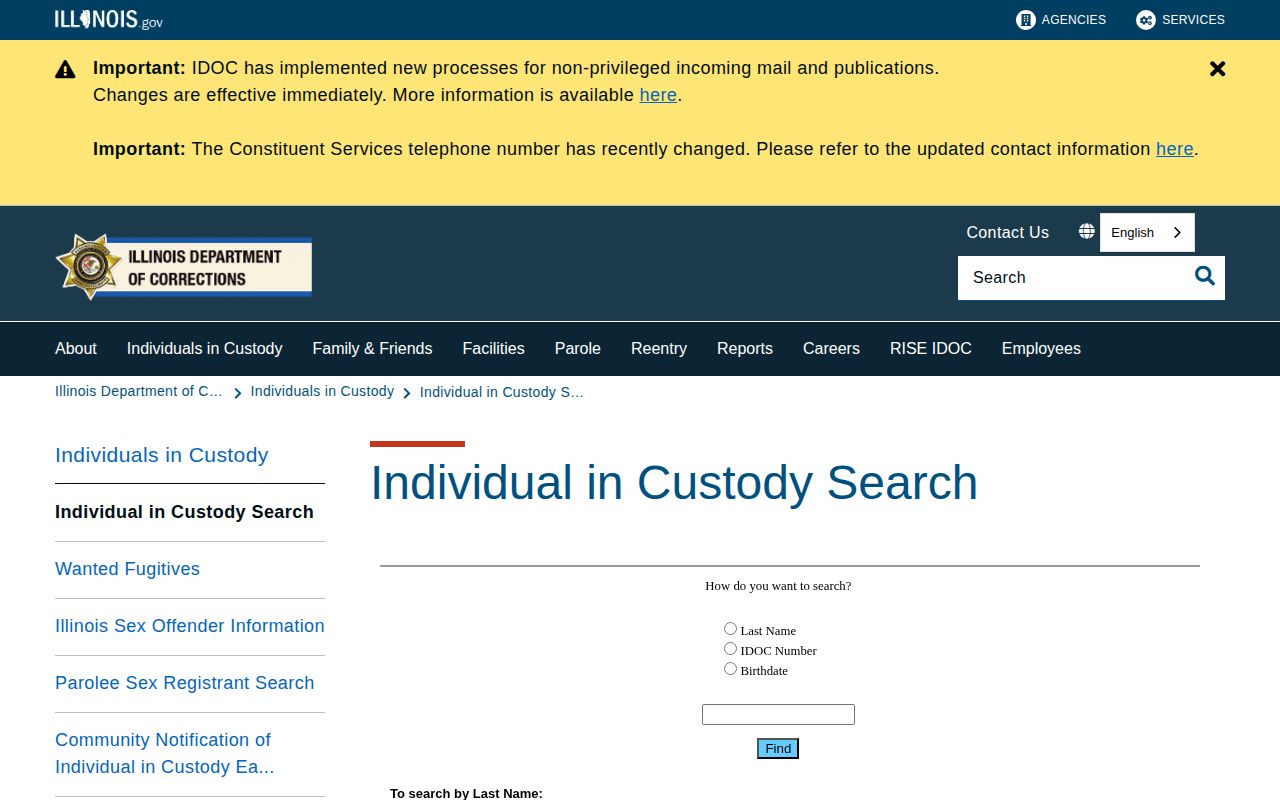
The screen is relevant only to IDOC custody or supervision, not a routine release from DeKalb County Jail.
DeKalb County Recent Release Limits
No verified DeKalb County Sheriff page publishes a released tab, rolling 24-hour list, or 72-hour list. The corrections menu provides jail services and VINE material, but no public release archive with a stated update schedule or photo field. The 2024 annual report counted 1,522 intakes and describes jail workload, not a list of releases.
For one person, VINE, a jail call, the court docket, and a focused Sheriff request are more reliable than an unofficial mirror. A date-bounded release log may be requested, though the agency has not promised real-time delivery and can apply lawful exemptions and fees. The DeKalb County 24-Hour Releases page sets out that fallback for the shortest time window.
DeKalb Jail Capacity Records
Old directories can conflict because DeKalb's jail changed over time. The first county jail dates to 1856, the Public Safety Building and Jail to 1980, and the 2018 expansion raised technical capacity from 89 to 140 beds. The Sheriff's 2024 report separately uses 112 as functional capacity because holding cells and operating limits differ from a raw bed count. Neither capacity figure states how many people were released on a given day.
DeKalb Post-Release Supervision
Three local and state systems must not be merged. DeKalb County Court Services handles court-ordered probation and pretrial supervision. The IDOC Parole Division supervises people after state-prison release on parole or mandatory supervised release. The Illinois Prisoner Review Board sets conditions and handles specified violation and discharge decisions.
A person ordered to DeKalb Pretrial Services must call 815-899-0751 immediately after release; the county says intake may be completed by phone. That contact supports a community release under conditions, not the end of the case. The distinctions and local contacts appear on the Post-Release Supervision page.
DeKalb Release Alerts and Transfers
Illinois VINE covers participating county booking systems, IDOC, DHS, and circuit-court events. Registration can use phone, text, or email. A release alert reports a supplied custody change, but may not say whether the cause was pretrial release, time served, dismissal, or transfer. Confirm the reason with the Sheriff record and court file.
Federal and immigration channels serve different roles. The BOP Inmate Locator covers federal records from 1982 forward and may show “Released” or “Not in BOP custody.” Neither phrase rules out supervision or another custodian. The ICE detainee locator is a current-custody tool, not a historical release database. No result can mean release, removal, transfer, delay, mismatch, or no ICE custody.
DeKalb Courts Explain Jail Release
The Circuit Clerk record often explains what a bare jail movement code cannot. Criminal, felony, misdemeanor, DUI, traffic, and ordinance dockets may show detention hearings, release conditions, judgments, sentence credit, probation, dismissal, or later sealing activity. A short DeKalb jail stay can leave no IDOC profile at all, while the court case remains the durable legal trail.
Still, the docket and jail record answer different questions. The docket proves judicial action. The Sheriff record gives the physical discharge or transfer time. Pairing them avoids treating a signed order as proof that processing was already complete, or treating an exit time as proof that all legal duties ended.
Where DeKalb Release Records Appear
Use the system aligned with the custody event. Each source has a clear boundary, and no single search covers every DeKalb County release.
| System | Best evidence | Does not prove |
|---|---|---|
| Sheriff custody record | County receipt, discharge, or transfer time | The full judicial reason |
| Circuit Clerk docket | Order, disposition, sentence, and conditions | The exact processing minute |
| IDOC profile | State custody, parole date, and projected discharge | A county-only jail release |
| VINE | A reported custody event and alert | Every legal detail |
| BOP locator | Federal custody or release date | State or county custody |
DeKalb County Release Facilities
DeKalb County Jail is the county's verified adult correctional facility. A person may leave for the community, IDOC, another county, medical care, or federal or immigration custody. Its Sheriff record and court case are the main local proof.
River Valley Juvenile Detention Center in Joliet serves DeKalb County youth. Juvenile confidentiality bars treating it as an adult public inmate search. Release or placement information must come through the committing juvenile court and authorized facility channels.